


- Patient Stories
- Professor Zhu




Professor Zhu's geological hammer finally rings again
My name is Zhu Xinglong. I am seventy years old this year. Before retirement, I taught at the China University of Geosciences and spent my entire life working with rocks. Until May 2025, I had always believed I was still in good shape—after all, for a geologist, carrying samples over mountains and valleys during younger years was second nature. But there was one thing I truly neglected: a 35-year history of hepatitis B. Because I was constantly in the field, I never received regular treatment. By the time I retired and wanted to take better care of myself, it was already too late.
This spring, my appetite suddenly collapsed. After just a few bites, I felt bloated. The mere smell of cooking oil made me nauseous. My abdomen kept swelling, like a balloon being inflated. My legs were also swollen—pressing a finger left a deep pit. My wife urged me to see a doctor, but I stubbornly insisted I was fine. Eventually, I could no longer bear it. I went to West China Hospital for a check-up—and there it was: a mass on the left lobe of my liver, 12 centimeters across, a giant lesion. The report also noted moderate ascites, moderate anemia, and liver function markers more than three times the normal upper limit.
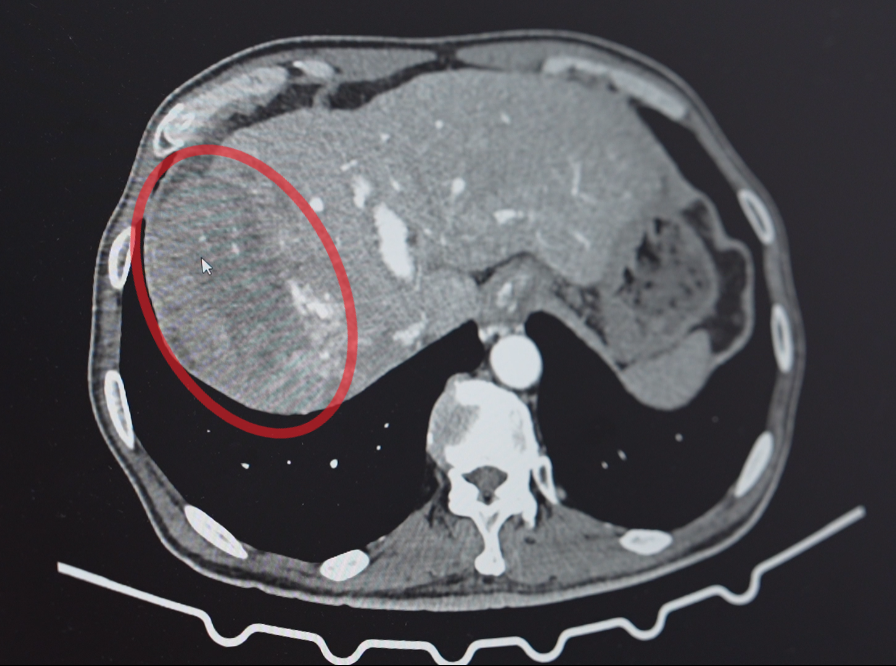
(Image: CT scan at diagnosis shows the massive liver tumor with liquefaction necrosis, indicated by the red circle.)
In the field, I have seen all kinds of rocks—hard granite, fractured shale, and deformed phyllite. But I had never encountered anything that made my legs feel weaker than the word "cancer."
Over the next month, my son took my scans to several major hospitals. The specialists' responses were largely the same—at 70 years old, with a tumor this large, too close to major vessels, severe cirrhosis with ascites, and liver function this poor, surgery was out of the question, and chemotherapy could not be used either. Some doctors put it gently, others bluntly—but the message was identical: there was no effective option left.
As a geologist, I know exactly what "too many uncontrolled variables" means—when there are too many variables and none can be stabilized, any plan remains just theoretical. At that moment, I was the old problem deemed "uncontrollable."
My wife cried secretly many times behind my back. I lay in bed, my stomach swollen like an iron pot overturned on me. What ran through my mind over and over was not death, but regret—regret for not taking my hepatitis B seriously during all those years in the deep mountains, and regret for putting off the trip to Yunnan to see the Stone Forest with my wife after retirement, postponing it again and again.
My son did not give up. He did extensive research and finally identified a hospital called Uni-Asia. He told me it was an international high-end cancer hospital that brought together minimally invasive interventional experts from top public hospitals across the country—names like Zhang Jinshan, Xiao Yueyong, and Liao Zhengyin, figures who are indispensable in the field of interventional radiology in China. They specialize in one thing: using a thin catheter, without open surgery, to address tumors that have been written off by conventional methods.
"Dad, they don't have to cut you open," my son said.
That statement struck a chord with me. Anyone who works with geology knows that sometimes going around a mountain is smarter than blasting through it.
At Uni-Asia Hospital, Professor Liao Zhengyin studied my contrast-enhanced CT scans for a long time. Unlike other doctors who frowned, he looked up with steady eyes and said, "Professor Zhu, your case is indeed complex. But we have identified the vessels feeding the tumor—there are just a few main ones. My plan is to do it in two sessions. We'll enter through the artery in your groin, deliver the medication directly into the tumor, and then block the feeding vessels. The first session will target the main battlefield; the second, after an interval, will clean up the peripheral branches. Step by step."
I asked him, "I'm seventy, and my liver function is so poor—can I withstand it?"
He replied, "Precisely because your liver function is poor and systemic chemotherapy is too risky, this is the very path we must take. The drug goes straight into the tumor, bypassing the rest of the body, placing much less burden on the liver."
After hearing that, I felt grounded. All my life in geology, I have believed in one principle—precision strikes are always more effective than indiscriminate bombardment.
I walked into the interventional suite on my own feet for the first procedure. Lying on the table, watching the DSA machine move overhead like a giant mechanical arm, I was momentarily reminded of the days when I calibrated X-ray diffractometers in the lab. Only this time, it was the "ore vein" inside my own body being scanned. Professor Liao and his team worked in perfect sync. Occasionally, I heard calm, confident voices: "Catheter in position." "Drug infusion complete." "Embolization satisfactory." Within less than an hour, I was bandaged and wheeled back to my room.
The next day, I was already out of bed. Apart from a rice-sized puncture site at the groin, there were no surgical wounds on my body. What surprised me even more was that my appetite slowly began to return. On the third day after the procedure, my wife brought me a bowl of rice porridge—and I finished it all. That was the first time in nearly two or three months.
After an interval, I underwent the second procedure. Professor Liao said the first session had been highly effective, and this time they would clean up the remaining small feeding branches. After the procedure, a follow-up contrast-enhanced CT was done. Professor Liao placed the two sets of scans side by side on the light box and pointed them out to me: "Professor Zhu, look—from 12 centimeters down to 6."
I stared at those two rows of black-and-white images, just as I once traced mineral veins on geological maps. Twelve centimeters to six centimeters—a full 50% reduction. Liver function markers had also dropped significantly. My abdomen had shrunk by several inches. The edema in my legs was gone. I no longer walked as if stepping on cotton. My wife said I finally had color back in my face.
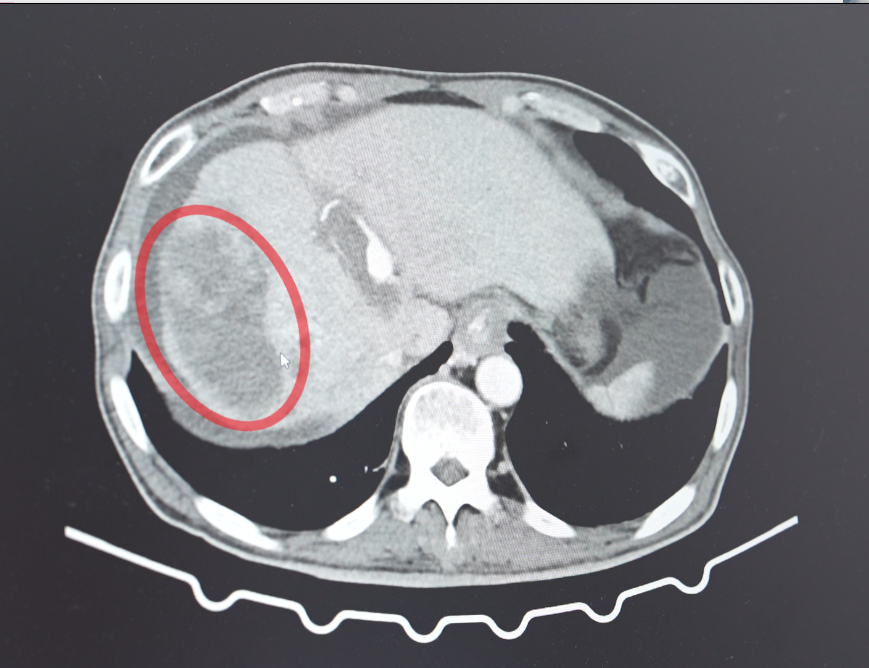
(Image: Follow-up CT after two interventional sessions shows the tumor reduced by half.)
Now I am recovering at home. Every morning, I take a few laps around the garden in our neighborhood. I flip through my old geological atlases and call old friends. Once I feel stronger, I will definitely take my wife to Yunnan to see the Stone Forest. I have spent my entire life studying geological wonders formed over billions of years, but I never took her to see them with her own eyes—that debt must be repaid.
A few days ago, while tidying my study, I came across my old geological hammer from my field days. I held it in my hand, feeling its weight—it still has heft. I thought to myself: when spring comes, maybe I can still take my students out for fieldwork. So what if I'm seventy? Professor Liao helped clear the "mine disaster" inside my body. This old frame of mine can still strike a few more resounding notes.
This case is a real patient experience, with personal details anonymized for privacy. It does not constitute a treatment guarantee.