


- Patient Stories
- Shu Yuanzhi





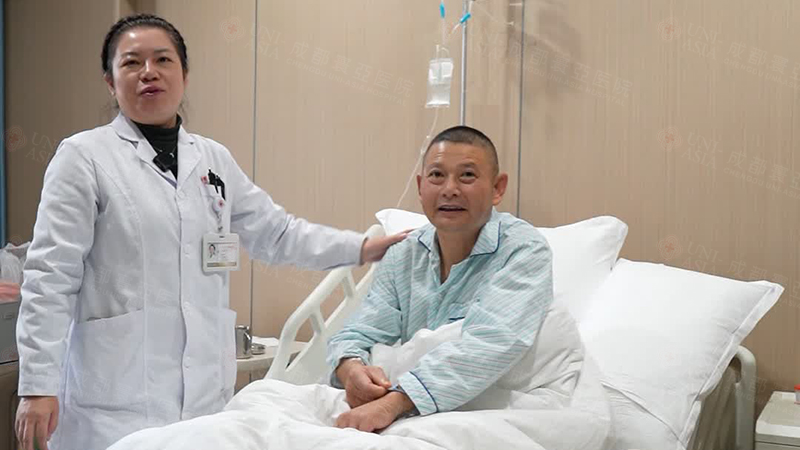
The Panda-Blooded Man Who No Longer Has to Gamble with His Life
My name is Shu Yuanzhi. I'm 57 years old and a true-blue Chengdu native. The blood flowing through my veins is rare—Rh-negative, what people call "panda blood. " I used to think it was just a cool label. Occasionally the blood bank would call and ask me to donate, and I'd happily go. But I never imagined that one day this "rarity" would become a sword hanging over my head.
Earlier this year, I started feeling a dull ache in my upper abdomen. I had no appetite and was losing weight day by day. I went to West China Hospital for a check-up—pancreatic head cancer, locally advanced. The doctor said the tumor was still confined around the pancreas and hadn't spread all over the abdomen, so in theory it was still treatable. But the moment he pulled up my blood type report, his brow furrowed: "You're Rh-negative?"
What he said next sent chills down my spine. The area around the pancreatic head is one of the most complex anatomical regions in the human body—the superior mesenteric artery and vein and the portal vein form a dense web around it. Traditional surgery is a major procedure in itself, with high intraoperative bleeding risk. And with my Rh-negative blood, which is in extremely short supply, if a massive hemorrhage occurred during surgery, the blood bank might not have enough matched blood to save my life. The doctor put it bluntly: "Surgery is possible, but you need to be prepared—the risk is far greater than for an ordinary patient."
After leaving the hospital, I sat by the roadside for a long time. Cars streamed past, but my mind kept circling back to one thought: I've lived fifty-seven years—am I really going to die because of my own blood type?
My family was frantic. My daughter searched everywhere online – panda blood, pancreatic head cancer, surgical risks, alternatives... keyword by keyword. Finally, she found a hospital called Uni-Asia Cancer Hospital, which offered a technology called "NanoKnife," specifically designed for tumors tightly wrapped in major blood vessels—and it involved no bleeding. My daughter held her phone in front of me, showing Uni-Asia Cancer Hospital's introduction: an international high-end cancer hospital that had gathered China's top minimally invasive interventional experts—Liao Zhengyin, Zhang Jinshan, Xiao Yueyong, and others. Many patients who had been written off by conventional treatments had found a way out here.
"Dad, they don't have to open you up," my daughter said. "No bleeding means we don't have to worry about not finding blood."
I stared at the screen for a long time and said, "Let's go."
At Uni-Asia Cancer Hospital, Professor Liao Zhengyin spent a long time studying my contrast-enhanced CT and vascular reconstruction images. He called me over to the lightbox, pointed at the black-and-white images, and said, "Mr. Shu, look—your tumor is right at the pancreatic head, right next to the superior mesenteric artery and portal vein. It's like being wrapped in several large pipes. To operate here with traditional surgery is like trying to defuse a bomb in the middle of a tangle of water pipes—if you accidentally nick one, the bleeding could be catastrophic. Add to that your panda blood, and no one dares take that risk."
He paused and pulled up another image: "But Nanoknife is different. It doesn't use high heat to burn, nor extreme cold to freeze. Instead, it uses ultra-short high-voltage electrical pulses to create nanoscale pores in the tumor cell membranes, causing the cells to undergo apoptosis. The key is that it only attacks cells—it leaves vascular and bile duct structures, which don't have cell membranes in the same way, virtually untouched. In other words, I can confidently ablate right next to major blood vessels without worrying about rupturing them. Whether you have panda blood or ordinary blood, there's almost no bleeding during the procedure and no risk of major hemorrhage afterward."
I understood roughly what he meant. Seeing that I was still frowning, he gave another analogy: "Think of it like an electrical wire—the Nanoknife burns out only the copper core inside, while the outer insulation remains perfectly intact. The blood vessels and bile ducts are that insulation."
"Can this technique get all of it?" I asked.
"For locally advanced pancreatic head cancer, Nanoknife has had quite a few successful cases internationally. For your case, I'm confident we can do a thorough job."
On the day of the procedure, I walked into the interventional suite myself. Lying on the operating table, watching the CT-guided screen light up, Professor Liao and his team began precise positioning. They made several small punctures in my abdomen and inserted the NanoKnife electrode needles one by one. On the screen, I could see the trajectory of each needle, precisely avoiding blood vessels and accurately placed around the tumor's perimeter. Professor Liao occasionally murmured, "This position is good... the ablation zone is fully covered... vessel distance is safe." His voice was steady and assured.
Throughout the entire process, I was fully awake. There was no severe pain, no sense of dread that comes with major surgery.
After it was done, I made a point of asking: "How much blood did I lose?"
Professor Liao smiled: "Almost negligible."
The next day, I had a follow-up contrast-enhanced CT. Professor Liao hung the images on the lightbox, pointed at the ablation zone, and said, "Mr. Shu, look—the tumor area shows no enhancement at all now. The ablation is perfect. The surrounding vessels are intact: no bleeding, no pancreatic fistula—nothing."
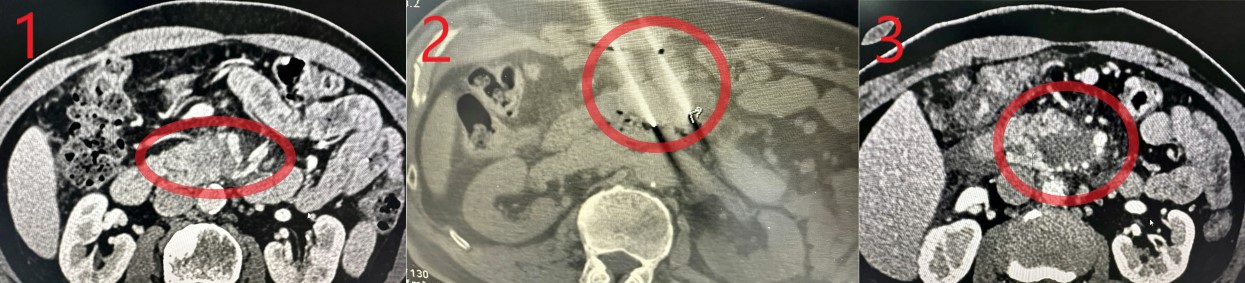
From left to right, the images show the patient's preoperative CT scan of the pancreatic tumor (Figure 1), intraoperative electrode placement (Figure 2), and postoperative follow-up imaging (Figure 3). The follow-up scan demonstrates complete tumor ablation with no damage to the surrounding normal tissues or adjacent organs.
I stared at those two rows of black-and-white images for a long time. That once-aggressive tumor had become a non-enhancing "blank zone"—it was dead, while I was still alive. And the "panda blood" that had caused me so much fear had never once come into play.
Now I'm recovering at home. I eat well and sleep well, and my weight is slowly coming back. My daughter says the color has finally returned to my face—even though my blood is still just as rare, at least I no longer have to worry about whether there's enough of it.
A few days ago, I went for a walk in the park and ran into an old neighbor. He asked why I'd lost so much weight. I said it was nothing – just a minor procedure. He asked what kind of surgery, and I thought for a moment and then said, "A new method—no incisions, no bleeding, and specially designed to protect precious people like me." He didn't understand, and I didn't elaborate. But silently, I thought to myself: Thank you, Uni-Asia Cancer Hospital. Thank you, Professor Liao. Thank you to the technology called Nanoknife—you protected a man with panda blood and gave him a way out without having to gamble his life on surgery.
This is a real patient story, with privacy protections applied. It does not constitute a therapeutic guarantee.