


- Patient Stories
- Xiao Li

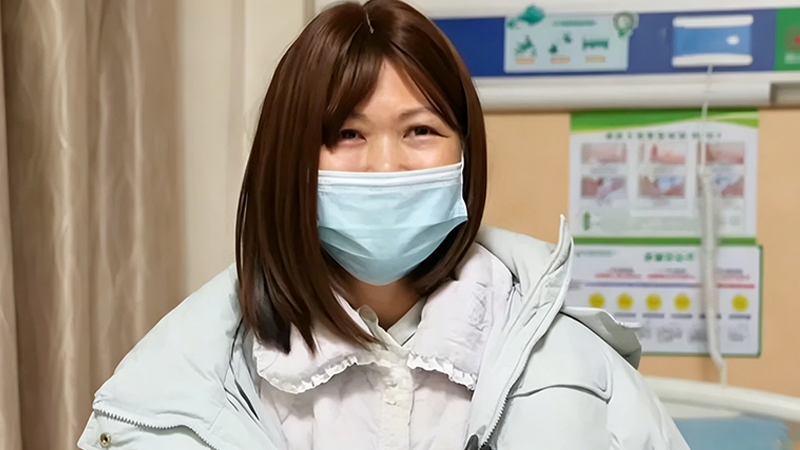
From 17 cm to Tumor Disappearance: A Late-Stage Breast Cancer Patient's Second Chance at Life
A breast cancer patient who had been suffering from the disease for 5 years dragged her weakened body to hospital after hospital, nearly at her wit's end. Despite her family's objections, she insisted, "Even if I have to crawl, I'll get there." After just a few sessions of arterial interventional embolization, her 17 cm tumor shrank to 7 cm and then disappeared completely.
Recently, we've seen many late-stage breast cancer patients at Uni-Asia Cancer Hospital. Some have massive tumors that have ulcerated and are draining pus. Others have had their bodies ravaged by chemotherapy but still can't control their disease. Many have been turned away by multiple hospitals and are almost out of options. Seeing them sit before me with thick stacks of medical records and eyes full of hope truly pains me. Today, I've set aside some time to share a real case I treated at Uni-Asia Cancer Hospital—a patient I will never forget.
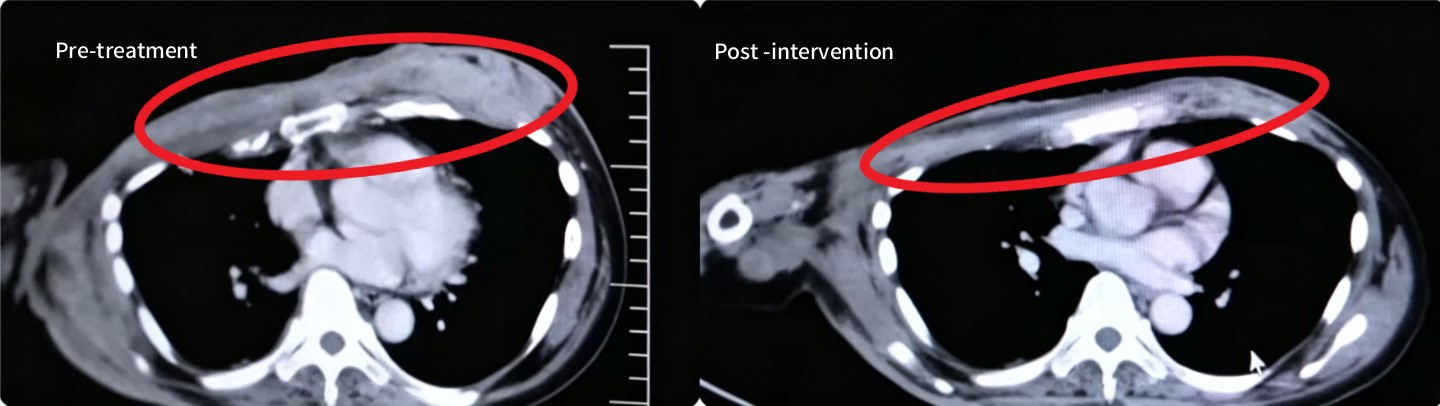
Image note: CT images of the patient's breast at presentation to our hospital (left) and after completion of all treatment (right), showing the breast tumor essentially disappeared.
——
A 17 cm Breast Tumor, Crushing the Breath Out of Her
She was diagnosed with invasive lobular carcinoma—a common type of breast cancer. At its largest, the tumor measured 17 cm.
What does 17 cm mean? A newborn's head circumference is about 10 cm. This tumor was heavier and bulkier than any organ in her body.
"It felt like something heavy was pressing on my chest, making it hard to breathe," she described.
Even worse, the wound began to drain pus. "The pus kept oozing out, soaking the waistband of my pants." She paused, her voice dropping. "And there was really a bad smell."
For a woman, breast cancer brings not only physical pain but also a profound psychological torment.
——
Dragging Her Weakened Body, She Went from Hospital to Hospital
"Back then, I was so weak and exhausted. I went to several hospitals, but none gave me satisfactory results. I went back and forth like this, and before I knew it, 5 years had passed."
Five years. More than 1,800 days and nights.
She tried chemotherapy. "After each session, I'd come home nauseous and vomiting, unable to eat. It was absolutely miserable. My hands and feet turned black, and it took six months to slowly recover."
She spoke these words in a very matter-of-fact tone. But I know just how much chemotherapy side effects can crush a person's spirit and body.
"Some people who go through chemo for this disease—they don't make it. I didn't want that outcome."
She said this very softly, but it struck my heart like a hammer.
——
After getting sick, I cut off all contact with friends.
"After I got sick, I cut off all contact with my friends. I didn't want to tell anyone. I was already in this state, and there was no better path forward."
She locked herself at home, not answering calls or replying to messages. Her daughter would come knocking every few days, and she'd say through the door, "I'm fine," then sit alone by the bedside, staring blankly at the lump on her chest growing bigger day by day.
"The hardest part was summer," she said. "As soon as the pus came out, even I couldn't stand the smell. I didn't dare go out or see anyone. I wouldn't even take out the trash until after dark."
——
A Glimmer of Hope Found in a Short Video
The turning point came in an otherwise ordinary moment.
"I came across it while scrolling through short videos," she said, her eyes lighting up.
She saw a woman with breast cancer—a big tumor that was bleeding and draining pus—and thought, "The smell was so strong you could smell it throughout the whole train car. " But that woman had undergone arterial interventional embolization at Chengdu Uni-Asia Cancer Hospital, and her tumor had visibly shrunk, her wound had dried, and she looked like a completely different person.
"My husband didn't believe there was such a technique. He said everything on short videos is fake—probably another scam." She pursed her lips. "But I didn't care what they said. No one else could help me anymore. I had to come see for myself. Even if I had to crawl, I'd get there."
On the strength of a single video on her phone screen, she decided to gamble one last time.
——
What Is Arterial Interventional Embolization? Why Is It So Effective for Breast Cancer?
At this point, many of you may be asking: What exactly is arterial interventional embolization?
In simple terms, arterial interventional embolization is a minimally invasive treatment technique that Professor Liao Zhengyin's team at Uni-Asia Cancer Hospital specializes in. A puncture site the size of a needle hole is made at the groin, and an extremely thin catheter is inserted. Guided precisely by DSA (digital subtraction angiography), the catheter is super-selectively advanced into the arteries that supply blood to the tumor.
Tumor growth depends on a blood supply, just as crops depend on water. Through the catheter, the doctor precisely infuses chemotherapy drugs and embolic particles to block the tumor's feeding arteries, cutting off its nutritional supply. Deprived of blood, the tumor undergoes ischemia, hypoxia, necrosis, and atrophy and is eventually absorbed by the body.
This is the principle of "starving" the tumor.
The advantages over conventional treatments are clear: extremely minimally invasive—just a pinhole, performed under local anesthesia, and patients can get out of bed the next day; no need for systemic chemotherapy, so patients feel better post-procedure and can eat normally; rapid results—usually after 2 to 4 treatments, the tumor visibly shrinks and necrotic tissue dries up; staged embolization to gradually eliminate the lesion; and for patients with locally advanced breast cancer who cannot undergo direct surgery, arterial interventional embolization can shrink the tumor, allowing some patients to become candidates for surgical resection or even breast conservation. It is especially suitable for patients with ulceration, bleeding, or pus drainage, as embolization cuts off the tumor's blood supply, allowing the ulcerated surface to quickly dry, scab over, and the malodor to disappear, dramatically improving quality of life.
This patient received exactly this treatment—precisely delivering medication to the arteries feeding her tumor, causing the 17 cm mass to lose its blood supply and gradually necrose, shrink, and dry up.
——
The Results Were Remarkable: The tumor shrank from 17 cm to nothing.
On the day she arrived at Uni-Asia Cancer Hospital, her husband had to help her out of the taxi. Professor Liao Zhengyin reviewed the scans and reports she'd brought from her hometown and carefully examined the ulcerated area on her chest. He said, "Although your condition has been going on for a long time, the vascular structure is clear—we can locate the main feeding arteries. We'll do the embolization in stages: first shrink this big mass, then clean it up completely."
She asked, "Professor Liao, my wound is already this bad—is there still hope for me?"
Professor Liao replied, "You've come all this way to trust me. I will not let you down."
She later told me she remembered that sentence word for word—not a single word was forgotten.
After her first embolization session, she felt a slight easing of the pressure on her chest that very night. The next day, when the nurse changed her dressing, she looked down—the pus that had been constantly seeping out had significantly decreased, and the edges of the wound were starting to dry. She froze for a moment, then tears streamed down her face. Not from pain—from joy.
"The results from this interventional treatment were remarkable. After just a few sessions, the tumor had shrunk and dried up."
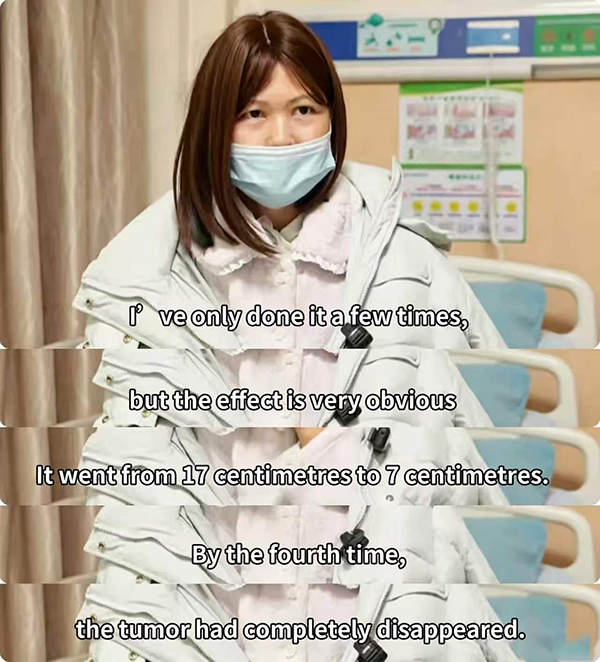
After completing the first course of embolization, the 17 cm tumor shrank to 7 cm. A few months later at follow-up, the 7 cm tumor was gone too.
"Before, the lump was on both sides here, but now it's basically flat."
Professor Liao hung the pre- and post-treatment CT images side by side on the lightbox for her to see. The enormous dark shadow on the pre-treatment image—like a stone pressing on her chest—was gone on the post-treatment image. Clean. Almost no trace. She leaned in to look, then stepped back to look again, back and forth several times, and suddenly broke into a smile.
When she said these things, there was a sense of relief in her voice—the relief of someone who had survived a near-death experience.
"The patient doesn't feel miserable, and the results are good—that's the greatest hope for us patients."
Yes. She was absolutely right. What do patients want? Not high-sounding theories, not fancy new treatments. Just this: they don't feel miserable, and it works.
——
I Remember Those Words
Just before she was discharged, she made a point of finding Professor Liao and said, "Professor Liao, you told me, 'You've come all this way to trust me, and I will not let you down.' I've held onto those words."
Professor Liao smiled and nodded. "I kept my promise, didn't I?"
She smiled too. "You did. I came here because of you. I felt at ease knowing you were the one treating me."
Those words made me both deeply gratified and heartbroken. Gratified that she had finally found an effective treatment. Heartbroken because of how many other breast cancer patients like her are still groping in the dark, unaware that such a light exists.
——
Now, She Dares to Go Out Again.
She came back for a follow-up a few days ago, wearing a floral-print dress. Her hair had grown back—jet black—and she'd gained about ten pounds. Her complexion was so good you'd never guess she'd been seriously ill. She told me she can now go downstairs to buy groceries and take walks in the park. She's reconnected with all those old friends she'd cut off for years.
"The happiest one is my daughter," she said. "She said, 'Mom, you've finally become the person you used to be.'"
She also told me that one day, while tidying up her closet at home, she came across the clothes she used to wear when she was sick—the collars and cuffs were all sewn with hidden snaps, covering everything tightly so no one could see the ulceration on her chest. She threw them all away. Every single one.
"Those clothes are for sick people. I'm not sick anymore."
As we saw her off, the sun was shining brightly. She walked out of the hospital gate, turned back, waved at me, and gave a brilliant smile.
Finally, I want to say this to every friend who is fighting cancer: You've come all this way to trust us—we will not let you down. Every doctor at Uni-Asia Cancer Hospital says this to every patient, and we always mean it.
This case is based on a real patient's experience, with privacy protections applied. It does not constitute a medical guarantee or promise of treatment outcomes.