


- Patient Stories
- Wang Xiaocai

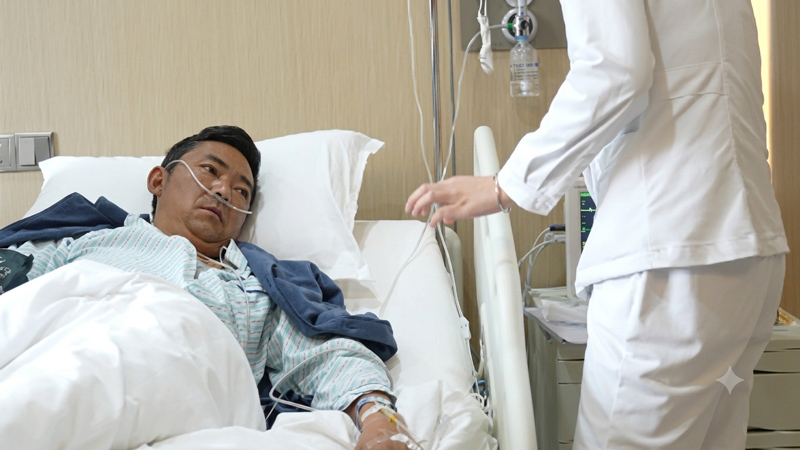
I Didn't Even Catch My Breath, but My Lungs Were Already Filled with Something
My name is Wang Xiaocai. I am 47 years old, from Xiaojin County, Aba Prefecture, Tibetan, and a farmer. Before the end of last year, I never imagined the word "cancer" would have anything to do with me. I didn't cough, my chest didn't hurt, and I breathed fine—no discomfort at all. I just went to Chengdu to visit relatives and happened to undergo a check-up. After the CT scan, the doctor stared at the images for a while and said to me, "There's something in your right hilum. You need to go to a major hospital for a closer look."
At the provincial hospital, I had a bronchoscopy and pathology reports—and the final diagnosis was lung adenocarcinoma, stage IIIb. It had spread to the hilar, mediastinal, and cervical lymph nodes. The doctor said the mass was right next to my trachea, and if left any longer, it would compress the airway and make it impossible to breathe. But at that time, I truly felt nothing whatsoever. It had been growing silently inside me for so long—just thinking about it now gives me chills.
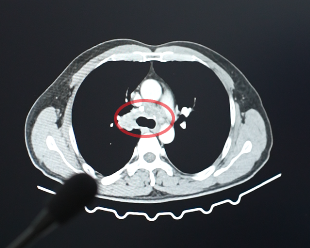
Image: CT image at diagnosis, showing the tumor clearly compressing the trachea
There were two paths in front of me. The surgeon said they could open my chest and remove part of the lung, but the tumor was too deep, the incision would be large, and recovery would take a long time. I've been farming all my life—the thought of lying in a hospital bed for months is unbearable. I was also afraid of chemotherapy and radiation. I heard from other patients that systemic treatments cause severe reactions—vomiting, hair loss, inability to eat, and drastic weight loss. I worried for days. I wanted to avoid both surgery and suffering.
Later, a fellow villager who does business in Chengdu told me about Uni-Asia Cancer Hospital in Chengdu—an international high-end cancer hospital that primarily treats foreign patients. It has a team of experts who came from the top three hospitals in China—names like Zhang Jinshan, Xiao Yueyong, Liao Zhengyin, and Luo Xiaoping—all well-known in the field. They don't do open surgery. Instead, they insert a thin catheter from the groin, thread it through the blood vessels all the way to the arteries feeding the tumor in the lung, deliver the drug directly, and then block those feeding vessels. My fellow villager gave an analogy: it's like a patch of weeds—you not only spray herbicide on them but also cut off the irrigation channel. Without water or nutrients, the weeds naturally wither. I understood right away—the healthy lung tissue wouldn't be affected, and systemic side effects would be minimal. I talked it over with my family that night, and the next day we went.
When I stepped into the hospital, honestly, I was a bit stunned. The lobby was spacious and quiet, the floors spotless, no crowds jostling to register, and no strong smell of disinfectant in the air. The front desk staff could speak several languages, and a few foreign patients were sitting on the sofas waiting—it felt almost like staying in a hotel. Not long after I settled into my room, Professor Liao Zhengyin came in with Director You Chunping. He pulled up a chair, sat down beside my bed, put my CT images on the lightbox, pointed at the dark shadow, and said, "Look here—the vessels feeding this thing in your lung—we counted several of them. Tomorrow, once you're on the table, I'll find every single one, deliver the drug where it's needed, and block them off." He spoke unhurriedly, like we were chatting in the village—no intimidating air at all. I asked him, "Will it hurt?" He waved his hand and said, "We'll give you a little local anesthetic at the groin. You'll be awake the whole time. Just speak up if anything feels off." Director You added, "After the procedure, you'll just lie flat for a few hours, and you can get out of bed the next day." After hearing that, the weight in my chest finally lifted.
On the day of the procedure, I walked into the interventional suite myself. After I lay down, they gave me a local anesthetic at the groin, and then I felt a thin catheter moving along inside my blood vessels. Director Zhang Wendong performed the operation, with Professor Liao supervising. I overheard them occasionally murmuring, "This one's in," "Drug delivered," and "This one's blocked too." On the screen above, I could see thin lines moving inside my body, but I felt no pain at all. The whole thing took just over twenty minutes. They bandaged me up and wheeled me back to my room.
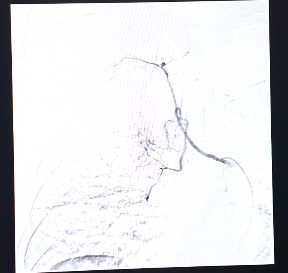
Image: Tumor staining clearly visible during the interventional procedure
Once back in my room, there was only one thing to do—lie flat. The puncture site at the groin needed pressure for a few hours, and my leg had to stay straight and still. For someone who does farm work, this was nothing. The next day, I was already walking in the hallway. Apart from a slight tightness at the puncture site, I felt pretty good. On the third day, the doctors made their rounds and said I was recovering well. I stayed only a few days in total before they discharged me. When I left, I carried my own things out the hospital gate, thinking to myself: this wasn't nearly as scary as I had imagined.
The doctor told me that in this treatment, we had blocked several of the arteries feeding the tumor. With nothing to eat, the tumor would gradually shrink. This cycle was done, and I would need to come back for more "clean-up" sessions. But the hardest first hurdle—I had already made it through.
On the way home, watching the mountains of Aba recede one after another outside the car window, I felt a deep sense of peace. The tumor was still there, but it could no longer grow wildly as before. I'll need to return to Uni-Asia for the next treatment in late March. I'm not worried. It's not the illness itself that scares people—it's not knowing where to turn. Now I can see the road ahead clearly, and I'll just keep walking it, step by step.
This is a real patient story, with privacy protections applied. It does not constitute a therapeutic guarantee.