


- Patient Stories
- Huang Peigen
The Agony of Not Being Able to Pee Is Worse Than Anything – My Prostate Cancer Treatment Experience at Uni-Asia Cancer Hospital
My name is Huang Peigen. I just turned sixty, and I run a small electrical repair shop in a county town. When I was younger, I fixed radios and televisions; later, I moved on to computers and phones. I've been at it for over thirty years. The shop isn't big, but all the neighbors know me. Whenever someone's induction cooker breaks or their rice cooker stops working, they bring it to me. I've never been one to ask for favors—I live by my skills. It's not a lavish life, but it's been steady and honest.
But about two years ago, my body started acting up.
At first, I kept getting up at night to pee. In the beginning, I'd get up two or three times a night. I didn't think much of it—at my age, prostate enlargement is common. All my buddies have to get up at night too. But then it got worse: five or six times a night. I'd barely lie down before I had to get up again. And even then, I couldn't empty my bladder—just a few drops at a time. I'd stand at the toilet for ages, straining, my lower belly bloated and painful, but nothing would come out. During the day, I grew more and more exhausted. My hands weren't as steady as before when I worked on repairs.
Later, I started feeling a dull ache in my pelvis. Sometimes it hurt so much I couldn't sit still, and standing for long periods while working on repairs became unbearable. My wife urged me several times to see a doctor, but I kept brushing it off—"It's nothing, just pop a painkiller, and it'll pass. "I'm a man, after all. How bad could it be?
Then one day, I went to the bathroom and saw blood in my urine. That's when I really panicked.
I went to the county hospital for tests. A blood test showed my PSA was through the roof. The doctor did a biopsy, and the result was prostate cancer. I stood in the hospital corridor clutching the report, my head spinning. My wife was in tears beside me. I said, "It's okay, it's okay—if you're sick, you treat it," but inside, I was terrified.
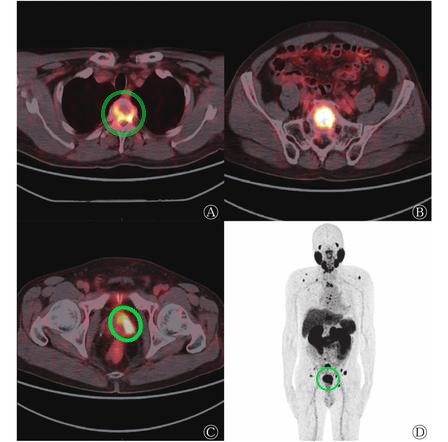
Image note: PET-CT image at the time of initial diagnosis, showing significantly increased metabolic activity in the prostate and surrounding lymph nodes
The doctor said I wasn't a good candidate for direct surgery and recommended endocrine therapy combined with chemotherapy. I figured, fine—no surgery is better; I'm old and didn't want to go under the knife anyway. But I had no idea that endocrine therapy plus chemo would be so much harder to endure than I ever imagined. Once the chemo drugs went in, I felt completely drained—nauseous, vomiting, unable to eat. My hair fell out in clumps, and my face turned dark and sallow. Worse still, although my PSA temporarily stabilized, it started climbing again once the drugs lost their effectiveness, and the tumor began progressing again. The pelvic pain grew more severe. I had to hold onto walls when walking. At night, the pain kept me awake through the entire night.
I visited several major hospitals in the provincial capital. The specialists all said more or less the same thing: advanced prostate cancer, surgery wouldn't make much difference, and you've already tried chemo, radiation, and endocrine therapy with limited results. One doctor quietly said to my son in the hallway, "Take good care of your father at home. Let him eat and drink whatever he wants." I understood what that meant.
During that time, I kept my shop's rolling door shut for three full months. Old neighbors called to ask why I hadn't opened up—I told them I'd gone back to my hometown. But in truth, I stayed cooped up at home every day, staring blankly at the TV. The worst part wasn't even the pain—it was not being able to pee. Night after night, I'd sit on the toilet, desperate to go but unable to, drenched in sweat from straining. No one who hasn't been through it can ever truly understand that feeling.
The turning point came through my niece. She works in Chengdu, and somehow she learned about a hospital called Uni-Asia Cancer Hospital that specializes in minimally invasive interventional oncology. She said they had gathered a team of top national experts, including Professors Liao Zhengyin and Zhang Jinshan. She told me the hospital used a non-surgical approach: threading a thin tube from the groin up to the arteries feeding the tumor, delivering targeted medication directly, and then blocking off the blood vessels to "starve" the tumor.
"Uncle, this method is minimally invasive and much gentler on the body. It's perfect for someone like you who can't have surgery and can't tolerate chemo," she said excitedly over the phone.
I was skeptical. "Starving" a tumor? Did that really work? But my wife chimed in, "We don't have any other options anyway. What harm is there in at least going to take a look?"
She had a point. It couldn't get any worse than where I was.
At Uni-Asia Cancer Hospital, Professor Liao Zhengyin studied my scans and lab reports very carefully. Unlike other doctors who furrowed their brows, he patiently explained things to me: "Mr. Huang, even though your prostate cancer is at this stage, the blood supply to the tumor can still be precisely targeted through interventional techniques. The arteries that feed the prostate come mainly from several branches of the internal iliac artery. Using DSA guidance, we can precisely locate those branches, deliver chemotherapy drugs directly into them, and then block the vessels with embolic particles. The advantage is that the medication acts directly on the tumor at concentrations dozens or even hundreds of times higher than systemic chemo while having minimal impact on the rest of your body."
"Will it fix my peeing problem?" That was what I cared about most.
Professor Liao nodded. "Once the tumor shrinks, the pressure on your urethra will ease, and you'll be able to urinate more normally. The pelvic pain will also improve, since much of it comes from the tumor pressing on surrounding tissues and bones."
Those words—"you'll be able to pee"—were all I needed to hear. "Let's do it," I said.
For the first interventional treatment, I walked into the procedure room on my own. Lying on the operating table, Professor Liao's team worked methodically, their voices calm and steady. A little local anesthetic at the groin, and then a thin catheter was inserted through the femoral artery. I could see the catheter's path on the screen. I stayed awake throughout, with no major discomfort. The whole thing was over in about an hour.
I rested in bed that night, and the next morning I tried walking around. Aside from a little soreness at the puncture site, I felt fine. But what really amazed me was that when I went to the bathroom that night, I could actually pee a little more smoothly than before—not a strong stream by any means, but at least I didn't have to sit there for ages.
"It's flowing. I think it's flowing." When I said that to my wife the next morning, her eyes immediately welled up with tears.。
After some time, I came back for a second and third treatment. With each session, I felt a little better. My urine flow got stronger, from a trickle to a proper stream. The number of times I got up at night dropped from five or six to two or three, and eventually, I could sleep straight through till morning. The pelvic pain gradually faded too—from being unable to sit or stand comfortably to being able to walk to the market on my own.
Professor Liao showed me the pre- and post-treatment CT and MRI results side by side. On the screen, the prostate mass had shrunk by more than half from its original walnut size, and the surrounding affected tissues had significantly improved. My PSA, which had been in the hundreds before treatment, had dropped to the near-normal range.
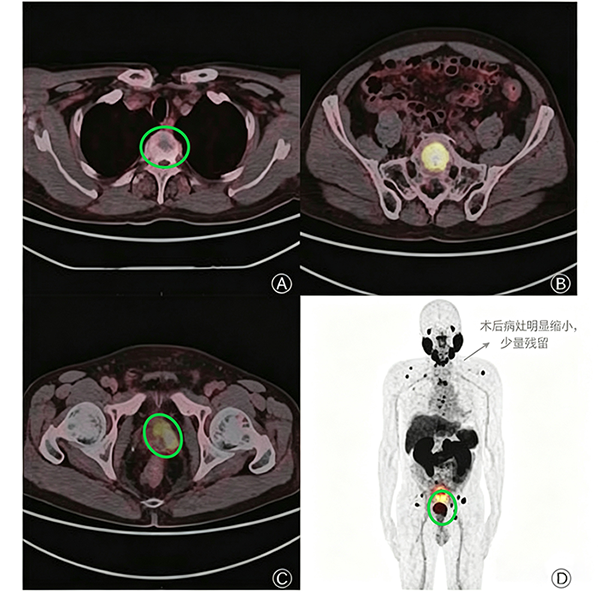
Image note: Follow-up prostate CT after completion of all treatment sessions, showing the lesion has essentially disappeared
"Mr. Huang, the results are excellent," Professor Liao said.
I stared at those two rows of images for a long time, then let out a long, deep sigh. That breath had been stuck in my chest for over two years. Finally, I could let it go.
After returning home, I reopened my electrical repair shop. When the old neighbors saw the rolling door go up, they all came over to say, "Old Huang, you're back!" Some brought in broken rice cookers to fix; others just stopped by to chat. I sat at my workbench, picking up my soldering iron and multimeter, feeling a sense of peace that was worth more than anything.
My wife says my complexion is even better now than before I got sick—I've put on some weight, and my voice carries more strength. The other day, my little grandson came over to visit. I scooped him up and lifted him high above my head. He giggled, and I laughed too. This kind of ordinary happiness—I used to take it for granted. Only after going through all this did I realize how precious it really is.
Someone recently asked me if I was afraid when I learned I had cancer. I said yes; of course I was afraid. But it wasn't the disease itself that scared me—it was not knowing which way to turn. When you find the right path and the right people, you find your footing. Uni-Asia Cancer Hospital and Professor Liao's team were the ones who helped me find that path and walk it all the way through.
I've never been one to ask for favors in my life. But this time, I truly have to thank them.
This case is based on a real patient's experience, with privacy protections applied. It does not constitute a medical guarantee or promise of treatment outcomes.